

I’m not sure whether it is worse to be ignored or pitied – but Nic Mitchell and Diana Beech say universities are about to find out!
Andy Burnham’s Labour government is ploughing on with plans to restore hope in Britain’s future without giving much more than a second glance to the contribution that higher education might make.
That’s the verdict from higher education stakeholders, like Diana Beech and John Blake, who made the trek up north to Liverpool to test the waters as the Labour Party faithful gathered for their first annual conference under new management.
Dr Beech had another pressing engagement in her role as director of the Finsbury Institute and assistant vice-president of policy & government affairs at City St George’s, University of London, and so missed the barnstorming speech on the final day by Labour’s new great helmsman.

But she had already picked up the vibes from party activists about how they felt about universities in the first two days of the annual conference – the first since Burnham, who is often called the ‘King of the North’, took over as leader (and UK prime minister).
Venturing outside the ‘bubble’
Unlike many in the higher education herd, who gather en masse at the annual conferences of the major UK political parties to talk largely to themselves at fringe events on the sidelines, Diana deliberately ventured away from the university ‘bubble’ to try to “understand and contribute to other policy areas and agendas”, as she put it to me.
It was a brave move, as outside the university tents, or exhibition stands and fringe meetings hosted by the likes of HEPI and Universities UK, there didn’t appear to much interest in what higher education was up, or how universities could contribute to the new government’s priorities.
There were no motions this year about university tuition fees that I could see. A few years ago the old left around then leader Jeremy Corbyn had wanted them scrapped.
John Blake, professor of social innovation and public policy at Salford University and director of the Post-18 Project, felt the same.
In his blog, titled ‘Labouring under a misapprehension’, Blake said that apart from people who work for universities talking to themselves, “the word ‘universities’ never passed the lips of conference delegates. See: https://post18.co.uk/labouring-under-a-misapprehension/
NEETS and apprenticeships
When it came to young people, the talk was all about NEETs (Not in Employment, Education or Training) and Alan Milburn’s big report and the importance of expanding apprenticeships.
Higher education didn’t seem to get a look in, despite universities being the largest providers of education and training in the country. It felt “distinctly odd”, said Blake.
Perhaps, the simple explanation is that universities – and problems over the financing of higher education and questions over the value of going to uni are too difficult to deal with.
And some of the university leaders haven’t exactly covered themselves in glory in recent times.
Fees rise call ignored
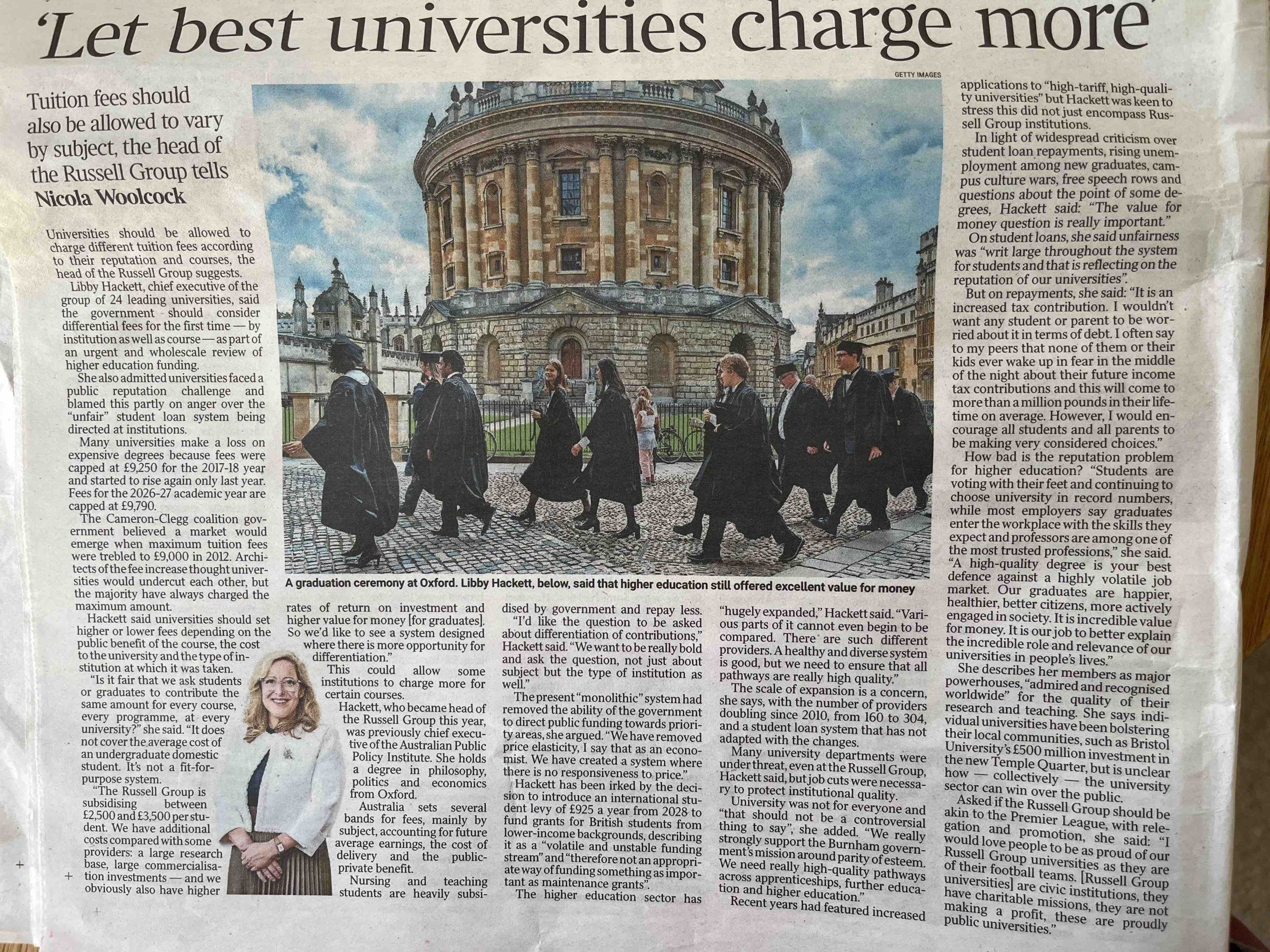
Take the Russell Group! Do you think their call for an increase in tuition fees in the run-up to this year’s Labour conference helped the cause? The demand from the self-appointed elite of the ‘Premier League’ university players used The Times as their loudspeaker (picture right). But it fell on deaf ears at Liverpool.
Diana Beech says: “Whenever I told people at the non-HE events that I worked in the university sector, I was met with comments like: ‘That’s not in a great way at the moment’; ‘So is a university really going to go bust soon?’; ‘Rather you than me given the finances!’.
“So, I suppose the financial crisis of UK universities has cut finally through to people outside our sector.
“Although I am not sure the fact that people know us for the bad stuff, not the good stuff is quite the look we should be going for. Since when did we become a sector to be pitied?”
Diana said university leaders, and their representative bodies, “urgently need to give people a reason to take pride in us, not pity us”.
Splits and factions
Perhaps, one reason for why the plight of UK universities can so easily be overlooked is because the so-called ‘sector’, as it likes to be referred to, has more splits and factions than even the Labour of Conservative Parties on a bad day.
As well as the Russell Group, which seems only too keen to get-one-over the more common universities, there are rival groupings representing private institutions, middle-of-the-roaders and research universities who don’t want to join the Russell elitists (or who have been turned down for membership).
Universities UK is supposed to try to represent everyone, but that often seems an impossible job despite the best efforts of chief executive Vivienne Stern.
University vice-chancellors are sometimes their own worst enemies as they continue rewarding themselves with ever larger salaries and perks, through their tamed governing bodies, while closing down courses and making their workers redundant.
Universities can’t even agree on whether applicants to universities must have good grades at the school-leaver GCSEs, even if they are mature students who have worked in industry for decades.
So universities send confused messages. They want maintenance grants to return for poorer students and then kick off when the government introduces a levy on international students recruited to help pay of extra help for home students – despite that being a clear way to show the value of foreign students in keeping universities financially afloat.
I could go on and on, and probably will.
Burnham’s 3 priorities
But getting back to the big Liverpool conference and what else did we learn?
Well, the new prime minister set out his priorities in a barnstorming speech on the final day of the event in Liverpool, with 3 key points being warmly received.
These are:
- Build a National Care Service
- Seek a new relationship with Europe
- Reform the electoral system to make it more representative.
What universities need to do is see how they can contribute to helping those 3 things actually happen – and give it a break to going on and on about how they need more money for themselves.
Just holding out the begging bowl and asking for more (money), without making it clear that they are changing fast enough, or spending the money they have got wisely enough, isn’t the answer. Neither is cutting more and more jobs and courses.
It is all so negative and no wonder the Labour members would prefer to talk about apprenticeships and skills. That’s what the general public are also talking about.
Jobs and training are also what the new Chancellor, John Healey, is focusing on as he prepares for his first big budget.
And whatever, vice-chancellors may believe, it is pretty clear that helping the tens of thousands of young people not in employment, education or training (NEET) is a key part of Labour’s ‘making Britain hope again’ message.
What is much less clear is whether universities and higher education have a part to play in saving the NEET generation.
Forget about Tony Blair’s-priorities of ‘Education, Education, Education’ and getting half of young people to go to uni, Burnham and Healey want to pin their economic recovery around:
- Creating more apprenticeships
- Bringing manufacturing jobs back to the UK
- Undoing privatisation of key areas of the economy.
People like Diana Beech and John Blake (and me) all believe that universities can, and should, have a big role to play.
But it is going to have to be on Burnham’s terms. So stopping trying to behave like Oliver at Christmas time holding out the begging bowl and asking for more money without offering what the Burnham government needs in return.
Main image: Andy Burnham addressing the 2026 Labour Party annual conference. Picture from Labour Party