

At first glance a new report from former government adviser Tom Richmond appears pretty radical with its 8-point toolkit to prevent “excessive risk-taking” by English universities, which have left nearly half facing deficits in 2025-26, according to the Office for Students (OfS).
Richmond’s recipe for the long-term survival of the higher education sector includes a student number cap; reducing reliance on international students and restricting franchising arrangements.
The report, (or HEPI Debate Paper 45) titled A degree of regulation: Building a more financially sustainable and resilient higher education sector has provoked some pretty stern reaction since it was published on 9 April, 2026 by the Higher Education Policy Institute – with a former chief executive of the University & Colleges Admissions Service (UCAS) calling it a “depressing read”.
Stifle innovation
Mary Curnock Cook, who now chairs of the governing body at the Dyson Institute of Engineering & Technology, took to LinkedIn to say while Richmond is not wrong in diagnosing many of the problems facing facing British universities, “his solutions would entrench existing models and stifle much-needed innovation”.
Meanwhile Jamie Warner, a chartered account on a two-year secondment as head of finance at Goldsmiths, University of London, accuses Richmond’s paper of “trying to solve financial fragility with prescriptive regulation”.
So, what is it that has upset some higher education experts and establishment figures?

Richmond, who worked briefly as senior research fellow for Policy Exchange, the influential, centre-right, think tank, was a senior policy advisor to the Secretary of State for Education in the Conservative-led government from 2013-2015, and his argument is that many universities have taken too many financial risks, which not only threatens their survival but also that of other institutions.
‘Absurdly fast’ growth
Richmond says: “Some providers have increased their student numbers absurdly fast in a race for extra tuition fee income. Canterbury Christ Church University has almost tripled in size over the last decade while Arden University has grown by over 3,000%.”
He also singles out Bath Spa and Buckinghamshire New University for growing rapidly through franchising, or subcontracted provision, saying: “Their use of franchising is so extreme that these universities now educate more students in franchised providers than they do on their own university campus.
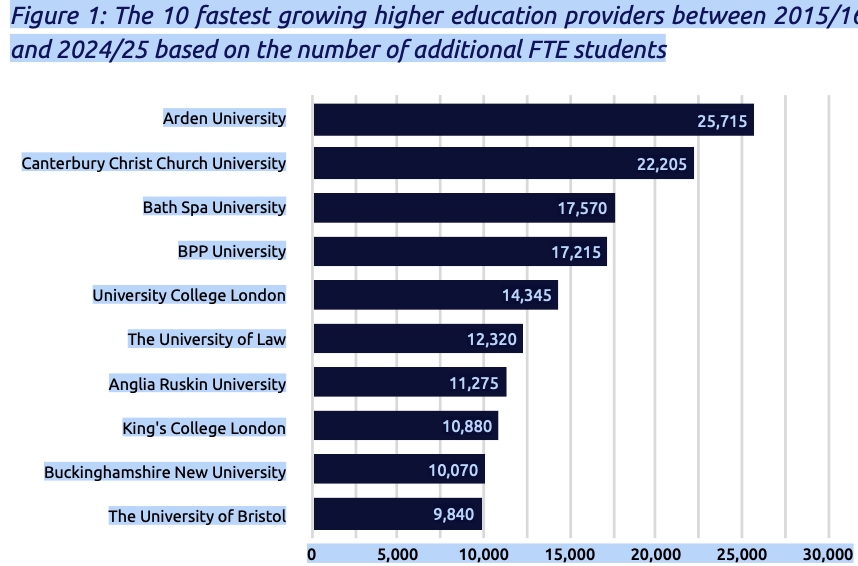
“The private franchised providers are, of course, happy to oblige. Global Banking School saw its franchised student numbers grow from 2,140 in 2019/20 to 32,110 in 2023/24.”
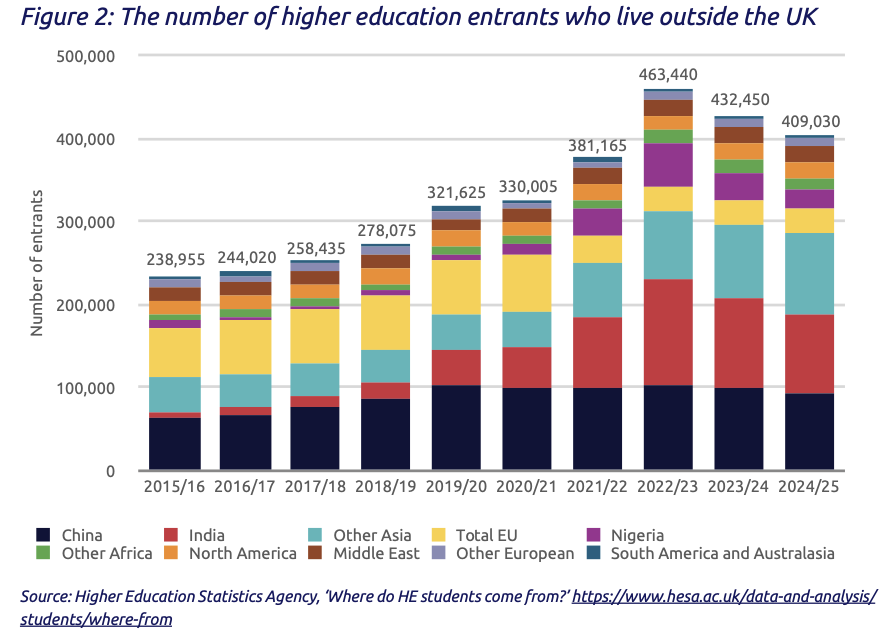
Richmond goes on to warn about the over-reliance of many universities on foreign students from one or two countries, despite “the volatility in international recruitment” and says ten providers now accept over 5,000 students a year from China and five universities accept over 5,000 from India.
‘Excessive borrowing’
“Excessive borrowing is yet another risk to the HE sector. Ten providers have debts equivalent to over 100% of their annual income, with the University of Northampton clocking in at 137%.”
Richmond says all this is having “a detrimental impact on students”, with higher-tariff providers hoovering up thousands of additional students since the (Covid-19) pandemic, but without “a commensurate increase in staffing – thus pushing academics’ workload to unsustainable levels.”
He also joins the chorus accusing universities of “recruiting more students than they can fit into their available accommodation” and “unjustified growth in top degree grade” – which he claims went up from from 7 per cent to 30 per cent over the past two decades.
Toolkit of solutions
Richmond’s ‘toolkit’ of solutions to the challenges facing higher education includes:
- Constraining provider growth in student numbers to 5 per cent annually
- Reducing reliance on international students, by only imposing the International Student Levy on fees above the maximum domestic fees
- Restricting income from franchising at no more than 20 per cent of provider income
- Implementing a ‘teaching resource cap’ on the number of undergraduate students that can be recruited and ensuring providers have enough physical space for the students they enrol
* Standardising degree classifications: limiting First awarded to 15 per cent of classifications ; 35 per cent as an ‘Upper Second’, 35 per cent as a ‘Lower Second’ and 15 per cent as a ‘Third’.
Some of this sounds common sense, albeit from a right-wing commentator.
International levy
I am particularly drawn to Richmond’s argument against a flat-rate international student levy of £925, which favours “providers that treat international students as ‘cash cows’ by recruiting more of them and by charging them higher fees,” as I reported for University World News last November 2025.
Richmond’s alternative solution is to “switch to a percentage-based levy that only applies to fees charged over and above the loan cap for tuition fees to domestic students” (£9,535 for undergraduate courses, £12,858 for Master’s degrees and £30,301 for doctoral degrees at the time of writing).
Even though this might raise less money for the government’s rather unfair funding of the return of maintenance grants for some (poorer) domestic students from the new international levy, it would at least mean that those universities charging the highest international-tuition fees would pay the most into the pot. Richmond suggests providers should pay a levy of 10% of any fees charged between £9,535 and £12,000, 20% of any fees from £12,000 to £14,500, 30% of any fees from £14,500 to £17,000 and so on.
However, Mary Curnock Cook is concerned that Richmond’s HEPI paper blocking provider growth “would actively discourages new delivery models that could widen participation and support economic growth”.

She also claims that expanding international students is good for the economy and UK soft power and not just universities.
More nuanced approach
While she accepts that abuses need fixing with franchising, Curnock Cook wants a more nuanced approach to other points raised in the HEPI paper, adding: “Tom’s paper prefers blunt regulatory intervention over strategic vision and leadership.
“At a time when universities urgently need room to experiment, adapt and rethink their models, his recommendations feel outdated and regressive.”
As for Jamie Warner at Goldsmith’s, the university’s head of finance says limiting growth to 5% would not allow an institution to catch-up if it had poor recruitment year and needed to catch-up the following year, as can happen in today’s volatile higher education environment.
So, what do others in my little black contacts book of HE policy wonks think about Richmond’s HEPI debate paper.
One, who followed Tom Richmond into trying her best to advise (Tory) ministers on higher education and research policy some years later (2018-19 to be precise) is Dr Diana Beech, now director of the Finsbury Institute at City St George’s, University of London.
No to number caps
Beech told me that while the HEPI report raises some valuable issues, particularly around the risks associated with the “bad apples” of the higher education sector, student number caps were not the answer.
She highlighted her own concerns about the sector’s performance in a HEPI paper last month, co-authored with Edward Venning, which I recently blogged about.
In that, Beech urged universities to up their game in shaping the national conversation around HE, including talking to the populists such as Reform UK.
However, Beech believes that before we reach for harder‑line regulatory solutions, there is much more sector bodies can do.
“For too long they have simply been champions of the sector rather than the critical friends we need them to be. They need to play devil’s advocate with their members, not simply public advocate.
“Strengthening the mechanisms for institutional accountability, improving transparent performance reporting, and investing in better measures of public sentiment would give government and regulators greater confidence that the sector is proactively managing risk.
“These steps would help calm political anxieties without resorting to blunt instruments that ultimately harm opportunity, diversity, and local economies,” says Beech.
Final word to Tom Richmond, who replied to Mary Curnock Cook on LinkedIn, by saying he was unconvinced that higher education leaders would stop their risky behaviour in the face of “overwhelming financial incentives for institutions to take more and more risks” and that “setting boundaries on what financial practices are acceptable / unacceptable is the best solution right now”.
Images from HEPI Debate report 45 by Tom Richmond.
- Also see ‘Significant challenges continue to face higher education finances – with nearly half facing deficits in 2025-26’ OfS report