
If I rediscovered my magic lamp and became Aladdin once again, I’d seek out one of my favourite free-thinkers on UK higher education policy and ask her how to fix the ‘crisis’ facing universities, with a score or more reportedly on the brink of going bust.
For anyone on the merry-go-round of conferences and navel-gazing events organised by the likes of Universities UK or who regularly reads the Times Higher, PIE News or University World News, you probably realise I am talking about Diana Beech, who has worked in and out of government policy-making for as long as I can remember and is one of the most sought-after experts on the circuit.
Diana is now director of the Finsbury Institute at City St George’s, University of London, following a four-year stint transforming London Higher into an effective fighting force promoting (and defending) higher education institutions in the capital.

She’s also got form having worked for 15 months inside the pre-Boris Johnson Conservative government, advising three universities’ ministers on strategic higher education policy matters, which has given her poacher-turned gamekeeper insights.
No wonder, then, that we journalists make a beeline for Diana as we try to understand why universities aren’t better loved by politicians and the public.
So, with the magical powers I have bestowed on her, what are her three or four wishes to get UK universities back of their feet and put a stop to their endless chatter about the need for change, which makes vice-chancellors sound like Sir Keir Starmer’s Labour government, when nobody can see anything getting much better?
Honesty about differentiation
“If I really had hold of a magic lamp, the first thing I would change is our reluctance to have an honest conversation about differentiation in higher education,” Diana told me.
“We should stop universities all trying to do the same thing, which leaves almost everyone overstretched and underfunded. All, except the elite members of the Russell Group, that is!
“I would force the government to put their words into action and get serious about productivity, skills, regional growth by re-inventing something closer to the old Colleges of Advanced Technology (CATs) model, from which higher education institutions like City St George’s developed.”
Diana would avoid the crude ‘universities‑versus‑polys’ divide of old by creating “prestigious, well‑funded institutions with clearly defined missions focused on applied science, technology and regional industry, sitting alongside research‑intensive universities, which would have a different role and funding settlement.
Parity of esteem
“Both will be well-funded, both will be respected, and we would achieve a parity of esteem by recognising both as serving different communities.”
Diana told me she has been thinking about this a lot since joining City St George’s and learning about its tradition of applied specialist technical teaching aligned to the professions and applied research to support business and industry and she believes that parity of esteem (and funding) for technical and vocational education to equal traditional academic study would put into practice what politicians endlessly say they want to see.
“If the current Labour government, or indeed a future one, is serious about productivity, skills, regional growth and economic resilience, then it cannot simply stabilise the existing system. It needs to redefine what success looks like,” said Diana.
“We (government and sector) need to be honest and accept that not all higher education institutions are the same – and nor should they be!”
Different pathways
So, what I asked would her two different pathways look like?
“The research-intensives can continue to focus on blue-skies and frontier research, doctoral training and global knowledge exchange; funded properly for research excellence and high-cost provision.
“And they would be freed up from having to deliver for local communities and domestic priorities if there is another institution in the same region or city that can do this better.
Reviving the CATs
“The Colleges of Advanced Technology (CATs) revived for the 21st century would be prestigious and well-funded institutions focused on applied science, technology, engineering and professional education and deeply rooted in place and regional economies.
“Crucially, they would be recognised as national assets, not ‘universities that didn’t quite make it’.
To make her first wish a reality, Diana would “shift higher education funding away from a fragile market logic towards a more strategic national investment model”, with lower student tuition fees and government investment in applied teaching and applied research and shared university-industry infrastructure that boosts growth and productivity.
Sounds like something Starmer (or any other Labour prime minister) should welcome, I suggested!
Three other wishes
So, what about Diana’s three other wishes?
“My second is for a new framework that resets the funding model so it reflects those different missions. The current system incentivises volume and international recruitment over quality, resilience or public value.
“A lower, more stable home fee, combined with much more explicit public investment targeted at teaching‑intensive, regional and strategically important provision for the CATs, would be far healthier than the current dependency on cross‑subsidy (of home teaching from international student fees).
“Thirdly, I would put far greater weight on flexible and part‑time study because the student body is changing.
“The 18-year-old domestic population is soon set to shrink and the pace of change in AI and tech is causing rapid disruption in the labour market that will force people to up-skill and re-skill throughout their lives.
“That means we need to redesign the system around lifelong learning rather than assuming three years, full‑time higher education, predominantly for those aged 18–21, is here to stay.
“We talk about productivity, skills and growth constantly, but the structure of higher education still works against people retraining or up-skilling later in life.”
Reconnect to place
Finally, Diana would reconnect universities more explicitly to place.
“Not every institution needs to chase global league tables. Some should be empowered – and indeed rewarded – for being civic anchors, supporting local employers, public services and local communities.
“In cities and regions where there are more than one university, institutions should actively be encouraged to embrace different missions.”
What the higher education sector doesn’t need is just another tweak here or there, said Diana.
It is crying out for real change and “a funding and regulatory system that genuinely supports institutional diversity rather than pretending uniformity is strength”.
All sounds very reasonable unless you are a modern university that has been chasing international student tuition fees and has moved away from its roots of technical and vocational education, or a middle-ranking more traditional university that is losing ground to its better-known and more prestigious Russell Group rivals.
But, nobody (including Diana) believes the changes needed will be easy if we are to Make Universities Great Again.
- This blog imaging I was Aladdin and had his magic lamp to improve higher education follows a conversation I had last year with Sino-Anglo HE exert, Cheryl Yu, about what magic we both thought was needed to improve the UK’s international education strategy – https://www.delacourcommunications.com/three-wishes-for-the-new-uk-international-education-strategy/
* Also see my blog looking at a new HEPI report by Diana Beech and Edward Venning, which calls on higher education leaders and the academic community to wake up and smell the coffee and prepare for the growing likelihood of having to deal with a Farage-led ‘populist’ government – https://www.delacourcommunications.com/talk-to-the-populists-now-uk-universities-told/
and ‘Are we brave enough to admit that one size doesn’t fit all in higher education? in Diana’s Beechside views blog in The PIE News – https://thepienews.com/beechside-views-are-we-brave-enough-to-admit-that-one-size-doesnt-fit-all-in-higher-education/
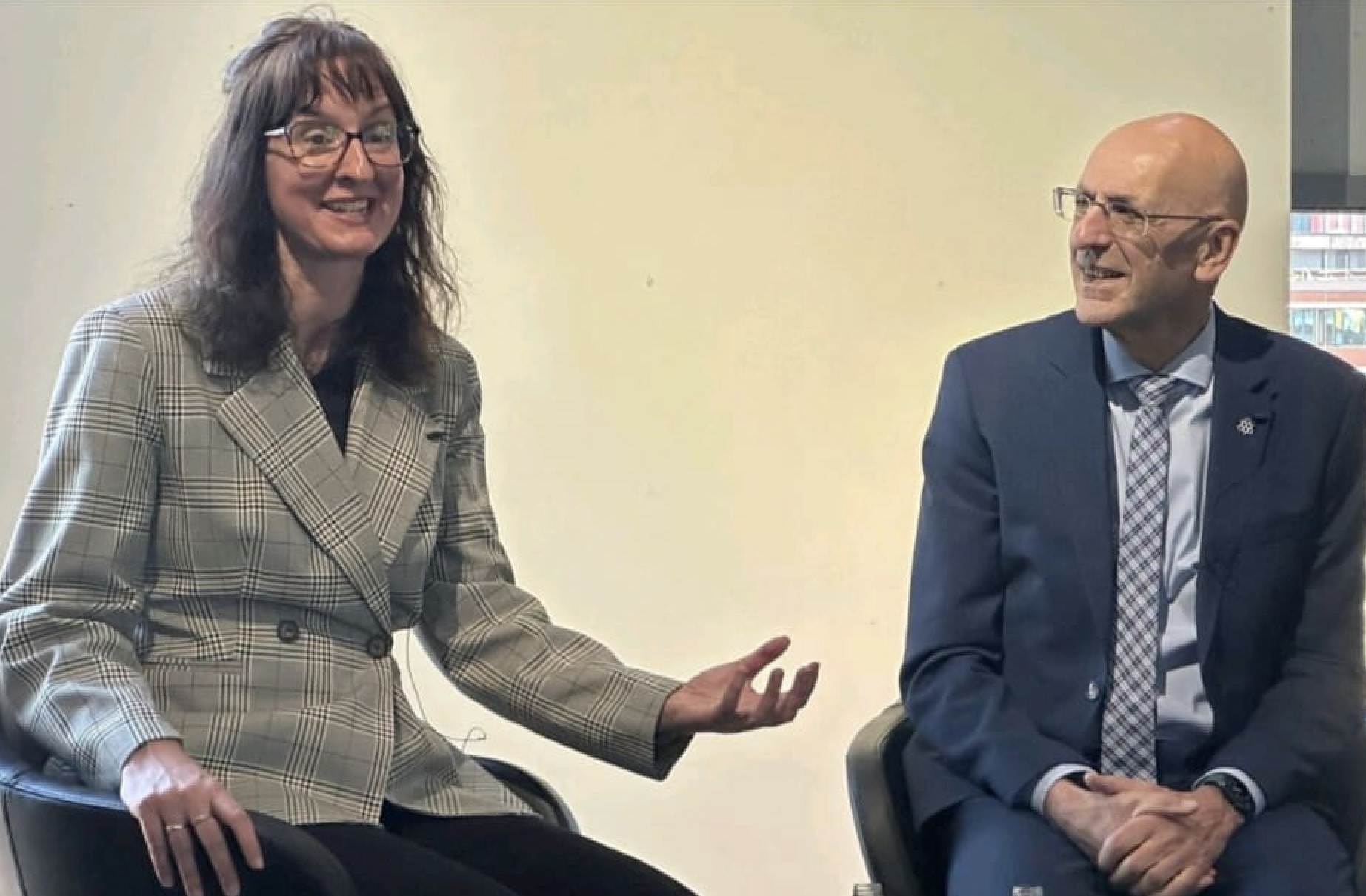
- Main image shows Dr Diana Beech with Professor Malcolm Press, President of Universities UK, during a ‘Leadership Forum’ with his top team at Manchester Metropolitan University in April. Malcolm is the university’s vice-chancellor.