

You’ve got to hand it to right-wing higher education think-tanker Iain Mansfield. He knows how to grab a headline in the ‘populist’ press and set the cat among the pigeons with his latest Policy Exchange report being splashed all over the front page of the Conservative-leaning Daily Mail under a banner headline asking ‘Is University A Waste of Money?’

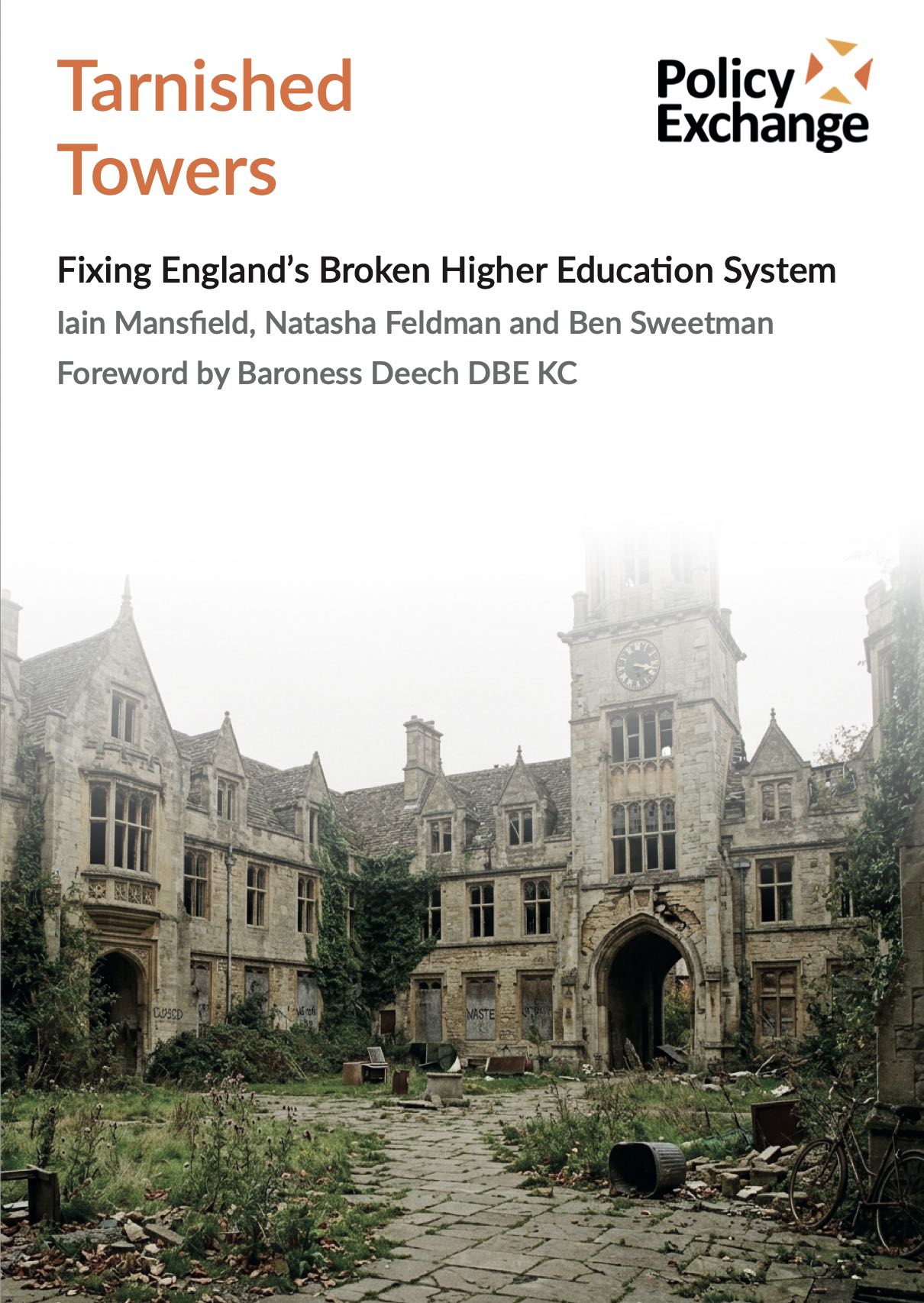
Here Dr Janet Ilieva, founder and director of the Education Insight international higher education research consultancy, joins me in exploring why Mansfield’s report, ‘Tarnished Towers: Fixing England’s Broken Higher Education System’ has provoked so much interest – and concern among UK university watchers!
While much of the media followed the Mail’s lead in focusing on the less than new ‘discovery’ that some graduates earn less than the average national wage five years after leaving university, the report’s main recommendations would (should anyone in government take them seriously) turn back the clock 30 or more years to the days when only a narrow elite went to uni.
Co-authored with fellow Policy Exchange wonks, Natasha Feldman and Ben Sweetman, the new report cleverly combines a few reasonable observations, such as the public losing confidence in a funding system that loads graduates with debt while subjecting universities to year-on-year cuts, with some outlandish recommendations that have managed to split the higher education establishment.
Minimum entry standards
Among the cheerleaders for at least some of the recommendations is Libby Hackett, chief executive of the Russell Group (a self-appointed ‘ivy league’ of 24 British research-intensive universities).
She welcomed the “robust debate” Policy Exchange had provoked about the future of the higher education system.
Hackett particularly supports the call for “a national minimum entry standard to study at university”, which she says, “cannot happen soon enough” and suggests it is being explored by the Department for Education.
This appeared to be confirmed in an “exclusive” story by the Guardian’s Education editor Richard Adams on 17 June, 2026, which reported that university students would be barred from student loans unless they have the minimum of at least a pass in GCSE English.
However, critics like Vivienne Stern, who leads Universities UK (the lobbying group which describes itself as the “collective voice” of 142 university vice-chancellors and principals) reacted to Policy Exchange’s report by saying: “It is not unusual to see a list of degree-holding commentators take a swipe at the expansion of the university system.
“A balanced analysis would note that holding a degree remains one of the best possible protections against unemployment.”
Too defensive
Janet and I reckon that Universities UK may have fallen into Policy Exchange’s trap by being too defensive in their response, particularly over graduate earnings. However, they obviously knew what line much of the media would take.
Far more alarming, in our view, are some of the reactionary recommendations among the 40-point Policy Exchange plan to turn back the clock to an age when just a small percentage of young people went to university. The so-called ‘good old days’ before that radical fellow, Tony Blair, was prime minister and a New Labour government set a target for 50% of under-30s to go into higher education.
The 50% goal was finally reached in 2017/18, as the BBC reported.
But clearly not everyone is happy at Blair’s ‘Education, Education, Education’ policy success.
Labour’s Lord (Maurice) Glasman, leader of the party’s Blue Labour faction, joined former Tory Home Secretary Suellla Braverman, who is now Reform UK’s Education spokesperson, and Conservative Shadow Education Secretary Laura Trott in endorsing Policy Exchange’s report.
Perhaps we shouldn’t be surprised as Gasman represents the culturally conservative wing of the Labour Party and has argued that mass expansion and marketisation has been a disaster for university policy.
‘Does not go far enough’
In his welcome piece, Glasman wrote: “The only problem with the paper is that it does not go far enough: rather than a 30% reduction in those going to university, I have said we should shut down half of them, and turn them into technical colleges.
“But the direction of travel is spot on: we need fewer graduates, more apprentices and a much stronger alignment of university funding with Britain’s industrial strategy.”
In Braverman’s contribution, she pledged that Reform (if it became the next government) would “shut down worthless degrees” and “end the preferential treatment of foreign students”.
So what exactly is it that Mansfield and his fellow authors advocates to get universities out of their crisis and a system which the ‘Tarnished Towers’ report describes as in “melt-down”.

Cut student numbers
Well, first they want to reimpose institutional-level student number controls to reduce student numbers by 6% year-on-year for five years, with the cuts “targeted at institutions with the highest drop-out rates, lowest progression to highly skilled employment or further study and lowest earnings”.
Money saved from the 30% reduction in university students should, says the report, help fund more apprenticeships and extra places in further education colleges and increase the higher education teaching grant to create “a fairer sharing of the funding burden between the student and state”, especially for higher cost clinical and STEM subjects.
Policy Exchange also wants to freeze (home) tuition fees for five years and abolish real interest rates on student loans.
However, the sting would be reducing the salary threshold at which graduates start repaying the loan to £15,000-a-year to ensure more of the government-backed loan is repaid. Depending on when the loan was taken out, repayments currently start when graduates earn over £25,000.
Policy Exchange suggests that graduates should repay 3% on earnings over £15,000; 6% on earnings over £25,000 and 9% on earnings above £35,000.
All sounds reasonable until you realise it would help the better off, especially as Mansfield and co., would scrap real interest on Plan 2 student loans (which the Labour government has been pressurised in fixing at no more than 6%).
Another way to help better-off graduates would be to make over-payments of loans tax-deductible.
Special treatment
So Policy Exchange are clear about who they think is worthy of special treatment and it is not the poorer students or those without the top traditional entry qualifications, like A-levels.
However, some of their ideas could prove popular with the 50% who don’t go on to higher education, such as broadening the Lifelong Learning Entitlement to those wanting to access ‘job-relevant qualifications” to work as HGV drivers, electricians, heat-pump installers or database managers.
For those that make the grade to enter HE, there’s stuff about making university sound tougher, such as cutting the number of Firsts, reforming the Office for Students regulator and introducing a national exit exam to test verbal, mathematical and analytical reasoning along the lines of the US GMAC.
Trump-style recommendations
Readers need to plough on to point 25 to get to the more meaty Trump-style recommendations, such as abolishing the current ‘Access and Participation’ regime and prohibiting UCAS from providing universities with contextual data on students, including sex, ethnicity, school-type, family background, Free School Meal eligibility and other demographic data. That should put a stop to all that trendy equality and diversity stuff favouring widening participation in HE.
However, to help the brightest few students from households where family income is under £25,000 who manage to achieve AAA or higher at A-level, Policy Exchange recommends introducing what it calls a ‘Double-Scholarship’ consisting of £3,000 maintenance grant per-year of study to the student and £3,000 teaching grant to their university.
For those who don’t achieve CCC or above at A-levels, the report wants a new University Aptitude Test before allowing students access to student loans.
This would severely cut the student intake at places like the creative industry focused Ravensbourne University, situated in the shadow of London’s O2 Arena in Greenwich. The university was formed through merging three arts schools.
Despite boasting impressive alumni, including David Bowie and Stella McCartney, three quarters of its degree students lack formal entry qualifications, as The Times highlighted on 13 June in a story headlined ‘No A-levels? This uni will let you in anyway’.
International students
As for international students, now a financial lifeline for many (including Russell Group universities), Mansfield’s report wants the government to impose a 30% cap for each institution on the proportion of foreign undergraduate students.
This sort of clampdown on undergraduate international students is a flashback to the days when net migration went out of control to around 900,000 after Boris Johnson’s mess of a Brexit EU withdrawal agreement and the press seized on claims by Suella Braverman and her Tory colleagues that foreign students were taking prized top spots at British university from UK students as universities chased higher international tuition fees.
However, most international students in the UK study at the Master’s level and demand is falling, largely thanks to the Home Office’s tougher student visa compliance rules designed to weed-out fake student applications from would-be asylum-seekers and non-genuine study applicants.
Tougher compliance
These new rules setting completion rates thresholds create much tougher compliance than set by the English higher education regulator for home students and are not achievable by any comparator country.

Janet has created a table from an OECD report from three weeks ago, ‘International Students in Higher Education’, which shows the international comparisons, with full-time undergraduate completion rates in England at 90% for international students (88% for domestic students). This compares with 77% bachelor’s completion rates for foreign students in Australia (63% for home students), while Canada’s comparative figures are 73% for international student completion rates (74% for home students).
So, the UK is already ahead of its rivals in value-for-money terms for both foreign and home student completion rates.
Setting targets that are almost impossible for some universities to reach without drastically restricting recruitment from any country where students may claim asylum just sends the message that England no longer wants students from many parts of the world and questions the international competitiveness of the UK HE system.
It also increases reliance on students from China, where completion rates are among the highest and nearly all students return home after finishing their degrees.
How all this fits in with the Labour government’s new international education strategy and its aim to boost education experts to £40 billion is a mystery and we don’t think most of the Policy Exchange recommendations provide the solution.
However, like Libby Hackett and the Russell Group, we all like a good robust debate around higher education.
And what Mansfield and his colleagues have done is set out policies that a Reform UK led government might try to introduce should Nigel Farage become prime minister.
So, the Policy Exchange report is worth looking at in some detail as university vice-chancellors and people like Vivienne Stern at UUK may have to try their best to work with a British populist government within a few years.
That’s unless ‘the Left’ in all its shades of red, green and orange can create some sort of alliance to stop the forward march of the populists and prevent the next government becoming a British version of Trump’s US administration with its war on Woke and academic freedom and university autonomy.
- Main image ‘Hats off to the class of 2026’ at Teesside University. Picture by Judy Hume.
- Also see my blog from March 2026, ‘Talk to the populists now, UK universities told’.